
Direct Anterior Hip Replacement in Flint, MI: A Modern Approach to Hip Replacement

Persistent hip pain can affect nearly every part of daily life—from walking and climbing stairs to sleeping, working, exercising, and enjoying time with family. When hip arthritis or significant joint damage no longer responds adequately to nonsurgical treatment, total hip replacement may be considered. For appropriately selected patients, direct anterior hip replacement offers a modern approach that accesses the hip joint from the front through a natural interval between muscles.
Patients researching direct anterior hip replacement in Flint, MI often want to understand how the procedure works, who may be a candidate, what recovery can involve, and how an orthopedic surgeon determines whether the anterior approach is appropriate. This guide provides an overview to help patients prepare for an informed conversation with their orthopedic specialist.
What Is Direct Anterior Hip Replacement?
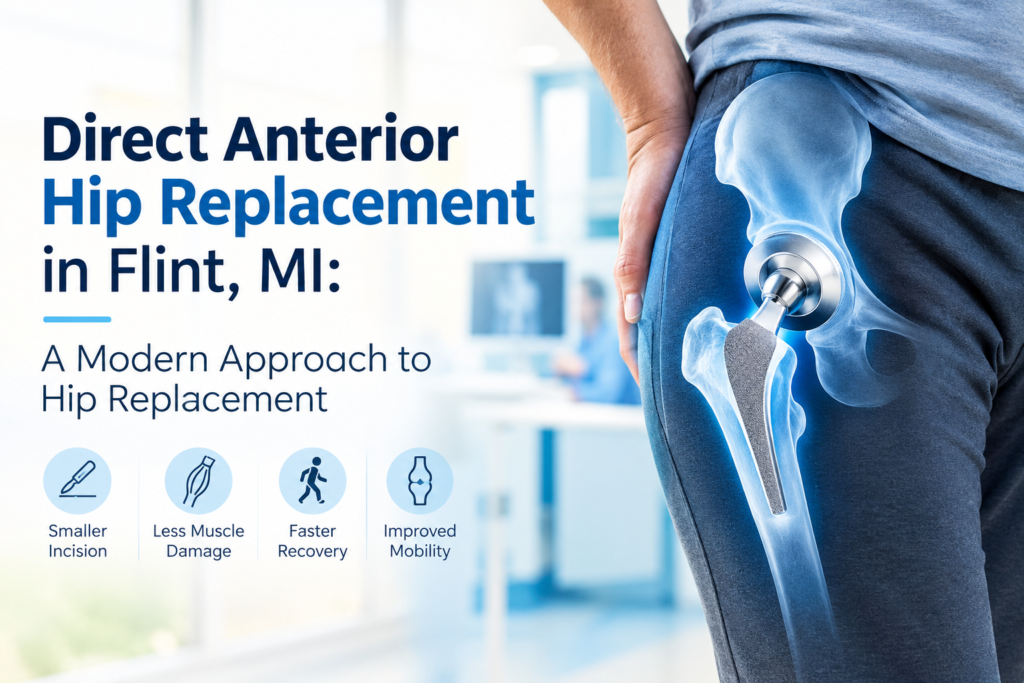
Direct anterior hip replacement is a surgical approach used for total hip replacement. During the procedure, the surgeon reaches the hip joint through an incision at the front of the hip. The approach can allow the surgeon to work through a natural interval between muscles rather than routinely detaching major muscles from the bone.
In total hip replacement, damaged portions of the hip joint are replaced with prosthetic components. The femoral head is replaced with an artificial ball and the damaged socket is prepared to receive an artificial cup. The goal is to reduce pain and improve hip function when joint damage has become significantly limiting.
Why Patients in Flint, MI Consider the Anterior Approach
The direct anterior approach has become an important option in modern hip replacement surgery. Its muscle-sparing nature may support earlier mobility and a smoother early recovery for some appropriately selected patients. However, no surgical approach is automatically best for every patient. The right approach depends on anatomy, diagnosis, previous surgery, bone quality, overall health, and the surgeon’s clinical judgment.
Potential Benefits of Direct Anterior Hip Replacement
- Front-of-the-hip surgical access to the joint
- A muscle-sparing approach in appropriately selected patients
- Potentially easier early mobility for some patients
- A structured pathway focused on pain control and early movement
- The opportunity to return gradually to everyday activities as healing progresses
- An individualized treatment plan based on the patient’s anatomy, health, and goals
Who May Be a Candidate for Direct Anterior Hip Replacement?
Direct anterior hip replacement may be considered for patients with significant hip joint damage whose symptoms are interfering with quality of life and who have not achieved sufficient relief from conservative treatment. Common symptoms include persistent hip pain, stiffness, reduced range of motion, difficulty walking, pain that affects sleep, and limitations in everyday activities.
A detailed orthopedic evaluation is essential before recommending surgery. Your surgeon may review your medical history, symptoms, physical examination findings, X-rays, overall health, and previous procedures. Patient anatomy and the complexity of the hip problem also help determine whether the anterior approach is appropriate.
Common Conditions That May Lead to Hip Replacement
- Advanced hip osteoarthritis
- Severe degenerative joint disease
- Significant cartilage loss and joint damage
- Certain hip fractures or other structural problems
- Persistent pain and functional limitations despite nonsurgical treatment
Direct Anterior vs. Other Hip Replacement Approaches
Hip replacement can be performed through different surgical approaches, including anterior, posterior, and lateral approaches. Each approach has potential advantages and limitations. Current orthopedic evidence does not establish one approach as universally superior for every patient.
For that reason, patients should focus not only on the name of the approach but also on whether it is appropriate for their specific condition and on the surgeon’s experience with the procedure. A personalized evaluation can help determine the most suitable surgical plan.
What Happens During Direct Anterior Hip Replacement?
After appropriate preoperative preparation and anesthesia, the surgeon accesses the hip through the front of the hip. The damaged femoral head is removed, the socket is prepared, and the artificial components are positioned to create a new hip joint. The exact implants and surgical details vary according to the patient’s anatomy, diagnosis, and surgical plan.
Modern hip replacement care may also incorporate imaging, specialized instrumentation, multimodal pain management, and coordinated rehabilitation when appropriate. These elements are intended to support safe surgery, early mobility, and a controlled recovery.
Recovery After Direct Anterior Hip Replacement
Recovery after direct anterior hip replacement varies from person to person. Some patients are able to begin walking soon after surgery, while the overall recovery process continues over the following weeks and months. Early mobility, appropriate pain control, physical therapy when recommended, and following postoperative instructions are important parts of recovery.
Patients should avoid comparing their recovery too closely with someone else’s. Age, general health, muscle strength, activity level, surgical complexity, and adherence to rehabilitation can all affect recovery. Your surgical team can provide individualized guidance about walking, driving, work, exercise, and other activities.
Preparing for Hip Replacement Surgery in Flint
- Complete recommended medical clearance and preoperative testing
- Review current medications with your healthcare team
- Arrange transportation and postoperative support
- Prepare your home by keeping walking paths clear
- Complete recommended prehabilitation or physical therapy preparation
- Follow instructions regarding nutrition, smoking, skin preparation, and other risk-reduction measures
Risks and Considerations
Like any major surgery, hip replacement has potential risks and complications. These can include infection, blood clots, bleeding, fracture, nerve or blood-vessel injury, dislocation or instability, implant-related problems, leg-length differences, persistent pain, and the possibility of additional surgery. The risks vary according to the individual patient and procedure.
The anterior approach also has approach-specific considerations, and it is not appropriate for every patient. A detailed consultation with an experienced orthopedic surgeon is the best way to understand the potential benefits and risks in your situation.
Why Choose an Experienced Hip Replacement Specialist in Flint, MI?
Hip replacement is an important decision, and choosing an orthopedic specialist with focused experience in adult joint reconstruction can help patients understand their options. Dr. Ajay K. Srivastava is a board-certified orthopedic surgeon in Flint, Michigan, specializing in adult hip and knee reconstruction, including minimally invasive anterior hip replacement and complex revision procedures.
His practice emphasizes patient-centered, evidence-based decision-making and individualized treatment planning. The goal is not simply to select a surgical technique, but to identify an appropriate treatment plan that supports pain relief, mobility, independence, and long-term function.
Questions to Ask About Direct Anterior Hip Replacement
- Am I a candidate for direct anterior hip replacement?
- Why is the anterior approach appropriate—or not appropriate—for my hip?
- What are the expected benefits and risks in my case?
- What type of hip implant will be used?
- How soon can I walk after surgery?
- When can I return to driving, work, exercise, and normal activities?
- Will I need physical therapy after surgery?
- What can I do to prepare for surgery and recovery?
Frequently Asked Questions About Direct Anterior Hip Replacement in Flint, MI
What is direct anterior hip replacement?
Is direct anterior hip replacement less painful?
How long does recovery take after anterior hip replacement?
Is anterior hip replacement right for everyone?
When should I consider hip replacement?
Where can I learn about direct anterior hip replacement in Flint, MI?
Talk With a Hip Replacement Specialist in Flint, MI
If hip pain is limiting your mobility or affecting your quality of life, an orthopedic evaluation can help identify the cause of your symptoms and determine whether nonsurgical treatment or hip replacement may be appropriate. For patients considering direct anterior hip replacement in Flint, MI, a personalized consultation can help clarify candidacy, surgical options, expected recovery, and the next steps.
Dr. Ajay Srivastava provides specialized adult joint reconstruction care in Flint, Michigan, with expertise in anterior hip replacement and other hip replacement procedures. Schedule an evaluation to discuss your hip pain and learn whether direct anterior hip replacement may be appropriate for you.