
Robotic Surgery
Home - Robotic Surgery
Get In Touch Us Today
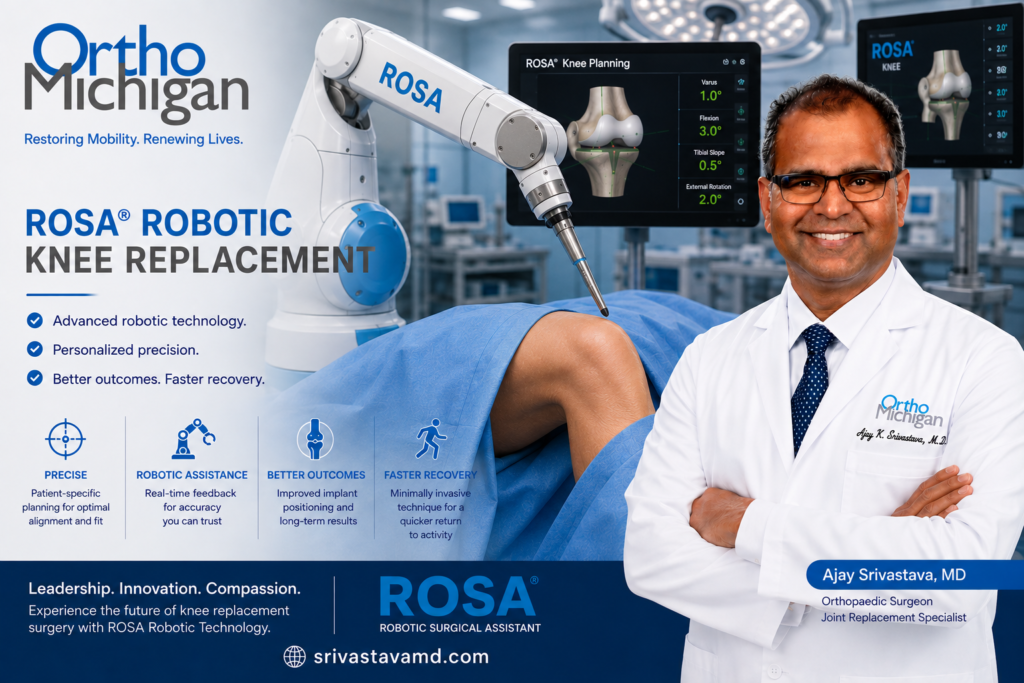
Advanced Robotic Surgery
Robotic-assisted technology has added a new level of precision and personalization to knee replacement surgery. I use advanced robotic systems, including the ROSA® Robotic System and the TMINI® Miniature Robotic System, to assist with surgical planning and execution. These technologies allow for precise bone preparation and implant positioning while helping tailor the procedure to each patient’s individual anatomy.
Robotic assistance is integrated with my overall approach to knee replacement, combining meticulous surgical technique with evidence-based practices and our Rapid Recovery Protocol. The goal is to achieve accurate implant positioning, preserve healthy tissue when possible, and support early mobility and recovery.
Robotic technology is a tool—not a substitute for surgical experience and judgment. I use these systems when they can provide meaningful benefit to the patient. Combined with extensive experience in knee replacement and modern pain-management techniques, our approach is designed to provide precision, comfort, and a faster return to the activities that matter most.
Advanced Robotic Surgery for More Personalized Knee Replacement
Knee replacement surgery has evolved with advances in imaging, surgical planning, and robotic-assisted technology. Robotic-assisted knee replacement can help surgeons plan and perform certain aspects of knee replacement with greater precision and personalization.
Dr. Ajay Srivastava uses advanced robotic systems, including the ROSA® Robotic System and TMINI® Miniature Robotic System, to assist with surgical planning and execution when appropriate.
These technologies can help with precise bone preparation and implant positioning while allowing the surgical plan to be tailored to each patient’s individual anatomy.
Robotic technology is a tool—not a replacement for surgical experience or clinical judgment. Dr. Srivastava combines robotic assistance with extensive joint replacement experience, modern surgical techniques, evidence-based care, and a Rapid Recovery Protocol to support a comfortable and efficient recovery.
What Is Robotic Knee Replacement?
Robotic knee replacement is a form of knee replacement surgery in which robotic-assisted technology helps the surgeon with planning and certain parts of the surgical procedure.
The surgeon remains in control throughout the operation. The robotic system does not independently perform the surgery.
Instead, the technology can assist with:
- Preoperative surgical planning
- Understanding the patient’s individual anatomy
- Bone preparation
- Implant positioning
- Alignment assessment
- Balancing the knee
- Maintaining surgical precision
- Personalizing the surgical plan
The specific technology and technique used depend on the patient’s condition, anatomy, and surgical needs.
How Does Robotic-Assisted Knee Replacement Work?
Robotic knee replacement generally involves several important steps.
- Detailed Surgical Planning
Before surgery, your surgeon evaluates your knee condition, anatomy, alignment, and imaging to develop an individualized surgical plan.
- Personalized Surgical Approach
The robotic system can help provide information about the patient’s knee anatomy and assist the surgeon in tailoring the procedure.
- Precise Bone Preparation
During surgery, robotic assistance can help the surgeon perform planned bone preparation accurately.
- Implant Positioning
The technology can assist with implant positioning and alignment according to the surgical plan.
- Surgeon-Controlled Procedure
The robotic system does not replace the surgeon. Dr. Srivastava remains responsible for surgical decisions and controls the procedure throughout the operation.
- Recovery & Rehabilitation
After surgery, robotic assistance is combined with pain-management strategies, early mobilization, physical therapy, and other elements of a comprehensive recovery program.
Robotic Knee Replacement vs. Traditional Knee Replacement
Both robotic-assisted and conventional knee replacement are performed by orthopedic surgeons to treat significant knee joint damage.
The primary difference is the technology used to assist with planning and execution.
Robotic-Assisted Knee Replacement | Conventional Knee Replacement |
|---|---|
Uses robotic-assisted technology | Uses conventional surgical instrumentation |
Can assist with individualized planning | Uses established surgical planning techniques |
Can assist with precise bone preparation | Surgeon performs bone preparation using conventional instruments |
Can assist with implant positioning | Implant positioning is performed using conventional techniques |
Surgeon remains in control | Surgeon remains in control |
Technology is selected when clinically appropriate | Conventional techniques remain appropriate for many patients |
Robotic surgery is not automatically better for every patient. The appropriate surgical approach depends on your anatomy, diagnosis, goals, and your surgeon’s assessment.
What Are the Benefits of Robotic Knee Replacement?
For appropriately selected patients, robotic assistance may provide several potential benefits.
Personalized Surgical Planning
Robotic technology can provide detailed information that helps the surgeon tailor the surgical plan to the patient’s individual anatomy.
Precise Bone Preparation
The system can assist the surgeon with controlled and accurate bone preparation according to the planned procedure.
Implant Positioning
Robotic assistance can help the surgeon evaluate and achieve planned implant positioning and alignment.
Individualized Treatment
Every knee is different. Robotic technology can help support a surgical plan that takes individual anatomy into account.
Preservation of Healthy Tissue
When clinically appropriate, precise surgical planning may help the surgeon preserve healthy bone and soft tissue.
Support for Recovery
Robotic assistance is incorporated into a broader treatment pathway that includes pain management, early mobility, physical therapy, and rehabilitation.
Is Robotic Knee Replacement Right for Everyone?
No.
Robotic-assisted surgery is a tool that may provide meaningful benefits for appropriately selected patients. It is not automatically necessary for every knee replacement.
Your surgeon may consider factors such as:
- Severity of arthritis
- Knee alignment
- Bone quality
- Joint anatomy
- Ligament stability
- Previous knee surgery
- Type of knee replacement required
- Overall health
- Surgical goals
Dr. Srivastava uses robotic technology when it can provide meaningful benefit to the patient, rather than using technology simply because it is available
ROSA® Robotic Knee Replacement
Dr. Srivastava uses the ROSA® Robotic System as one of the advanced robotic technologies available for knee replacement surgery.
The system is designed to assist the surgeon with:
- Surgical planning
- Knee anatomy assessment
- Bone preparation
- Implant positioning
- Alignment
- Intraoperative decision-making
The surgeon continues to make all important clinical and surgical decisions throughout the procedure.
TMINI® Robotic Knee Replacement
Dr. Srivastava also uses the TMINI® Miniature Robotic System.
TMINI is a compact robotic-assisted technology designed to support knee replacement procedures.
Like other robotic systems, it is intended to assist the surgeon rather than independently perform surgery.
The choice of robotic system and surgical technique depends on the patient’s individual anatomy, diagnosis, and treatment plan.
Why Choose Dr. Ajay Srivastava for Robotic Knee Replacement?
Specialized Joint Replacement Expertise
Dr. Srivastava is a board-certified orthopedic surgeon specializing in adult reconstruction of the hip and knee, including total knee replacement, partial knee replacement, robotic-assisted surgery, and complex revision procedures.
More Than 15 Years of Experience
Dr. Srivastava has more than 15 years of clinical experience and has cared for more than 5,000 hip and knee replacement patients.
Advanced Robotic Technology
His practice incorporates advanced systems including ROSA® and TMINI® when robotic assistance can provide meaningful benefit.
Evidence-Based Approach
Robotic technology is combined with evidence-based orthopedic care rather than being used as a replacement for clinical judgment.
Patient-First Treatment
Treatment decisions begin with understanding your symptoms, lifestyle, concerns, and goals. Surgery and technology are selected according to what is appropriate for your individual condition.
Comprehensive Recovery Program
Robotic-assisted surgery is part of a larger care pathway that can include multimodal pain management, early mobilization, physical therapy, and rehabilitation.
Robotic Surgery Is a Tool—Experience Matters
Robotic technology can provide valuable information and assistance during knee replacement surgery, but technology alone does not determine the outcome.
Successful joint replacement also depends on:
- Surgical experience
- Patient selection
- Accurate diagnosis
- Appropriate implant selection
- Surgical planning
- Soft-tissue management
- Pain management
- Rehabilitation
- Patient participation
Dr. Srivastava combines robotic-assisted technology with his experience in adult joint reconstruction and evidence-based orthopedic care.
What to Expect Before Robotic Knee Replacement
Your treatment begins well before the day of surgery.
Medical Evaluation
Your surgeon will evaluate your symptoms, medical history, knee function, imaging, and treatment history.
Surgical Planning
Your knee anatomy and alignment will be assessed to develop an individualized surgical plan.
PreHab & Physical Therapy
Preoperative physical therapy may help prepare your muscles and mobility for surgery and recovery.
Medical Clearance
Depending on your health, you may need clearance from your primary physician or other specialists.
Pre-Admission Testing
Preoperative testing may be required to evaluate your overall health and anesthesia needs.
Home Preparation
Arrange your home so that you have clear, uncluttered pathways and easy access to the things you use most often.
Transportation
Arrange transportation to and from the hospital and postoperative assistance as recommended by your care team.
What Happens During Robotic Knee Replacement?
On the day of surgery, your surgical team will prepare you according to your personalized surgical plan.
During the procedure:
- The surgical team prepares and positions you.
- Your knee anatomy is evaluated.
- Robotic-assisted technology is used to support the surgical plan.
- Damaged portions of the knee are removed.
- Bone preparation is performed with robotic assistance when appropriate.
- The knee replacement components are positioned according to the surgical plan.
- The surgeon evaluates knee balance, alignment, and function.
- The procedure is completed and postoperative recovery begins.
The robotic system assists the surgeon, but the surgeon remains in control of the procedure
Recovery After Robotic Knee Replacement
Robotic-assisted surgery is only one part of your recovery.
A comprehensive recovery program may include:
- Multimodal pain management
- Opioid-sparing strategies
- Early movement
- Walking with assistance
- Physical therapy
- Home exercises
- Strengthening
- Swelling management
- Follow-up appointments
Dr. Srivastava’s Rapid Recovery Program combines patient education, pain management, early mobilization, and rehabilitation to support recovery after joint replacement.
Your recovery timeline will depend on your individual health, procedure, rehabilitation, and progress.
Preparing for a Faster, Safer Recovery
Being prepared can make the recovery process easier.
Before Surgery:
- Complete your medical clearance.
- Attend recommended PreHab or physical therapy.
- Complete required preoperative testing.
- Arrange transportation.
- Prepare your home.
- Follow medication instructions.
- Maintain appropriate blood-sugar control if you have diabetes.
- Stop smoking if applicable.
- Maintain a nutritious diet with adequate protein and iron.
These preparation steps are included in Dr. Srivastava’s current surgical preparation guidance.
Robotic Knee Replacement in Flint, MI
If you are searching for robotic knee replacement in Flint, MI, it is important to understand that robotic surgery is not simply about using a robot.
The experience of the orthopedic surgeon, appropriate patient selection, surgical planning, implant positioning, and postoperative care all play important roles.
Dr. Ajay Srivastava provides robotic-assisted knee replacement in Flint, Michigan, using advanced robotic systems including ROSA® and TMINI® when appropriate. His approach combines technology with adult reconstruction expertise, evidence-based medicine, and a comprehensive recovery program.
Frequently Asked Questions
What is robotic knee replacement?
Robotic knee replacement is a knee replacement procedure in which robotic-assisted technology helps the surgeon with surgical planning and certain parts of the procedure, including bone preparation and implant positioning.
Does a robot perform the knee replacement surgery?
- No. The orthopedic surgeon remains in control of the procedure. The robotic system provides assistance and information to help the surgeon execute the planned procedure.
What robotic systems does Dr. Srivastava use?
- Dr. Srivastava uses advanced robotic systems including the ROSA® Robotic System and TMINI® Miniature Robotic System for appropriate knee replacement procedures.
Is robotic knee replacement better than traditional knee replacement?
- Robotic assistance may provide advantages in surgical planning and precision for appropriately selected patients, but it is not automatically the best choice for everyone. Your surgeon can determine whether robotic assistance is appropriate for your specific condition.
Is robotic knee replacement more accurate?
- Robotic-assisted technology can help the surgeon with surgical planning, bone preparation, alignment, and implant positioning. The actual outcome still depends on the surgeon, patient’s anatomy, implant selection, and other factors.
Is robotic knee replacement less painful?
- Robotic assistance itself does not guarantee less pain. Pain after surgery depends on many factors. A comprehensive pain-management strategy can help improve the postoperative experience.
Does robotic knee replacement have a faster recovery?
- Some patients may experience an efficient recovery, but robotic assistance does not guarantee a faster recovery. Rehabilitation, pain management, overall health, and the type of procedure all influence recovery.
Who is a candidate for robotic knee replacement?
- Patients with knee arthritis or other conditions requiring knee replacement may be considered for robotic-assisted surgery. The decision depends on the patient’s anatomy, diagnosis, surgical needs, and overall health.
Can partial knee replacement be performed with robotic assistance?
- Yes. Robotic-assisted technology can be used in appropriate partial knee replacement procedures. Whether it is appropriate depends on the patient’s arthritis pattern, anatomy, ligament stability, and other factors.
Can robotic technology be used for revision knee replacement?
- Robotic systems are primarily used according to the specific procedure and clinical situation. Revision surgery is more complex and may require different planning and technology. Your surgeon can determine what technology is appropriate for your case.
Will I need physical therapy after robotic knee replacement?
- Rehabilitation is an important part of recovery. Physical therapy and prescribed exercises can help restore strength, mobility, balance, and function.
How soon can I walk after robotic knee replacement?
Many patients begin moving and walking with assistance soon after surgery when medically appropriate. Dr. Srivastava’s Rapid Recovery approach emphasizes early mobilization and physical therapy.
How long does robotic knee replacement recovery take?
Many patients begin moving and walking with assistance soon after surgery when medically appropriate. Dr. Srivastava’s Rapid Recovery approach emphasizes early mobilization and physical therapy.
How soon can I walk after robotic knee replacement?
Recovery varies by patient. Many patients gradually return to routine activities over several weeks, while strength, mobility, and confidence may continue improving over a longer period.
Is robotic knee replacement available in Flint, MI?
Yes. Dr. Ajay Srivastava provides robotic-assisted knee replacement in the Flint, Michigan area using advanced robotic systems when clinically appropriate.
What are client's says about us
EXCELLENTTrustindex verifies that the original source of the review is Google. Posted on GoogleTrustindex verifies that the original source of the review is Google. Pleasant professional thoroughPosted on GoogleTrustindex verifies that the original source of the review is Google. Very professionalPosted on GoogleTrustindex verifies that the original source of the review is Google. Posted on GoogleTrustindex verifies that the original source of the review is Google. explained choices well and pros and cons.Posted on GoogleTrustindex verifies that the original source of the review is Google. Efficient and extremely good bedside manor. Positive experience.Posted on GoogleTrustindex verifies that the original source of the review is Google. Professional friendly office.Posted on GoogleTrustindex verifies that the original source of the review is Google. Posted on GoogleTrustindex verifies that the original source of the review is Google. Posted on GoogleTrustindex verifies that the original source of the review is Google. I felt so much better after talking to him…He’s sooo nice..