
Direct Anterior Hip Replacement: Modern Muscle-Sparing Approach

Clinical Advantages
How Is Direct Anterior Hip Replacement Performed?
After the skin incision is made, much of the deeper dissection is performed bluntly using the surgeon’s fingers to gently separate the natural interval between muscles rather than cutting through the major muscles surrounding the hip. Specialized retractors and instruments are then used to perform the hip replacement through this muscle-sparing exposure.
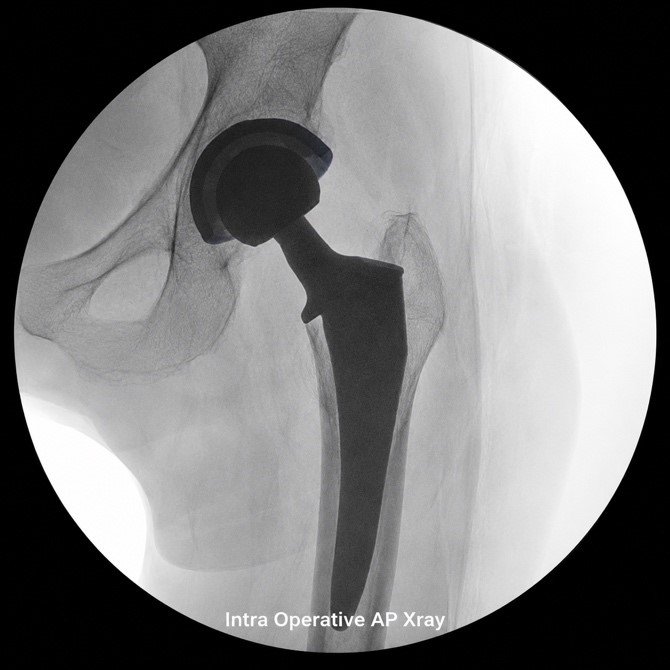
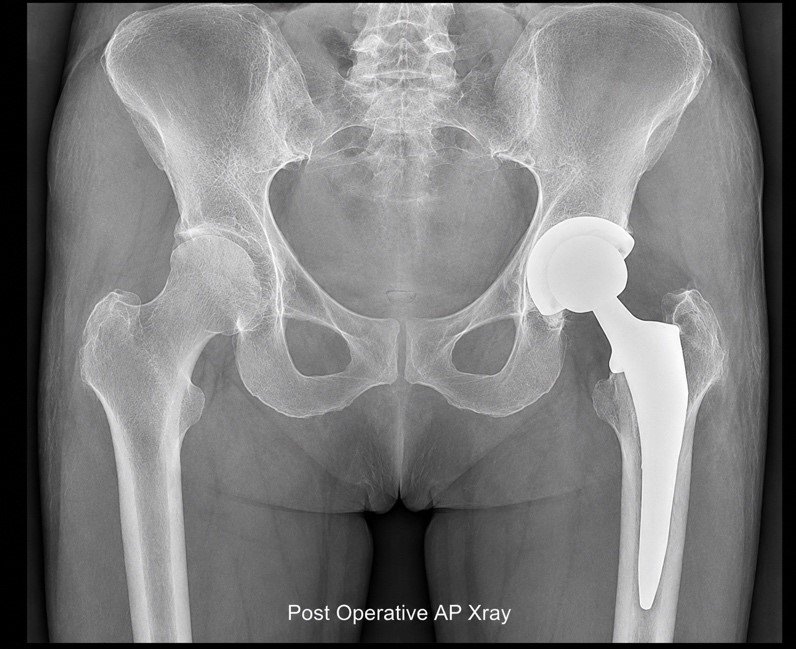
One of the most important advantages of performing the procedure in the supine position is the ability to use real-time X-ray, or fluoroscopy, during surgery. Attached intraoperative X-ray imaging shows appropriate implant and assess the size, position and angle of the acetabular cup, alignment of the femoral implant, hip offset, and leg length. Post operative image shows perfect alignment of total hip implant.
References
- Patel NN, Shah JA, Erens GA. Current Trends in Clinical Practice for the Direct Anterior Approach Total Hip Arthroplasty. Journal of Arthroplasty. 2019. Survey of 996 AAHKS members; 56.2% of respondents reported performing direct anterior THA.
- Courtney PM, et al. Current Practice Trends in Primary Hip and Knee Arthroplasties Among Members of the American Association of Hip and Knee Surgeons. Journal of Arthroplasty. 2023. Direct anterior approach was reported as the most utilized approach for primary THA among survey respondents (56%).
- Meermans G, Konan S, Das R, Volpin A, Haddad FS. The Direct Anterior Approach in Total Hip Arthroplasty: A Systematic Review of the Literature. Bone & Joint Journal. 2017;99-B(6):732-740.
- Wang Z, Hou JZ, Wu CH, et al. A Systematic Review and Meta-analysis of Direct Anterior Approach Versus Posterior Approach in Total Hip Arthroplasty. Journal of Orthopaedic Surgery and Research. 2018;13:229.
- Putananon C, et al. Comparison of Direct Anterior and Lateral Approaches in Total Hip Arthroplasty: A Systematic Review and Meta-analysis. Medicine (Baltimore). 2015;94(50).
- Direct Anterior Approach Versus Posterior Approach in Total Hip Arthroplasty: A Systematic Review and Meta-analysis. Meta-analysis of 27 studies involving 44,477 patients. The pooled dislocation risk was numerically lower with DAA (RR 0.78) but did not reach statistical significance.
- Post ZD, Orozco F, Diaz-Ledezma C, Hozack WJ, Ong A. Direct Anterior Approach for Total Hip Arthroplasty: Indications, Technique, and Results. Review of surgical technique including supine positioning and use of specialized HANA/fracture tables.
- Slotkin EM, Patel PD, Suarez JC. Accuracy of Fluoroscopic Guided Acetabular Component Positioning During Direct Anterior Total Hip Arthroplasty. 2015. Study of 780 procedures demonstrating the utility of intraoperative fluoroscopy for assessing acetabular component orientation.
- Anatomic Total Hip Component Position Is More Reproducible With the Direct Anterior Approach Using Intraoperative Fluoroscopy. Study evaluating component positioning with supine DAA performed on a HANA table with fluoroscopic guidance.
- Fluoroscopy-Guided Direct Anterior Approach Total Hip Arthroplasty Provides More Accurate Component Positions in the Supine Position Than in the Lateral Position. 2023. Demonstrated greater consistency between intraoperative and postoperative measurements of component orientation, offset, and leg length with supine fluoroscopic DAA.