
What Is a Total Knee Replacement?

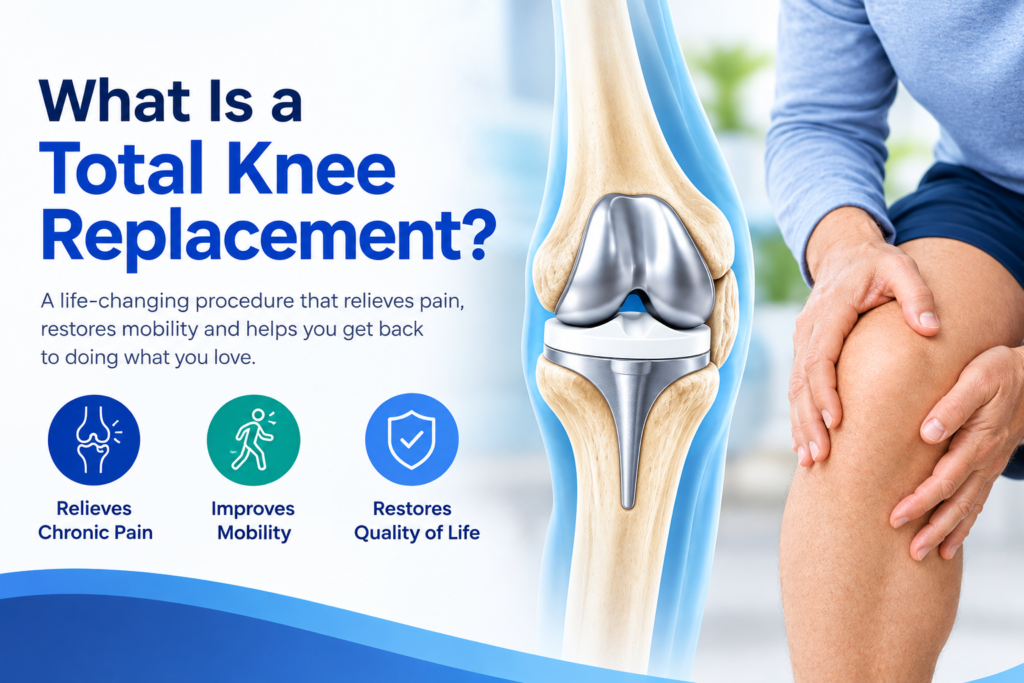
A total knee replacement, also called total knee arthroplasty, is an operation designed primarily to relieve pain and improve function in a knee damaged by advanced arthritis. Despite the name, the entire knee is not removed. Instead, the worn cartilage and a thin layer of damaged bone are removed from the ends of the thighbone, or femur, and shinbone, or tibia.
The damaged surfaces are then covered, or “capped,” with metal components. A durable polyethylene plastic insert is placed between the metal components, creating a smooth surface that allows the knee to move. The undersurface of the patella, or kneecap, is also resurfaced with a polyethylene component. Knee replacement implants are typically made from materials such as titanium, cobalt-chromium alloys, and polyethylene.
The primary goal of knee replacement is pain relief. Most patients also experience significant improvement in walking and daily activities. However, a replaced knee may not have the same flexibility or range of motion as a normal, healthy knee.
Anesthesia and Pain Control:
Total knee replacement can be performed under either general anesthesia or regional anesthesia, commonly called spinal anesthesia. The type of anesthesia is selected based on the patient’s overall health, medical history, and discussion with the anesthesia team.
Pain control after surgery uses a multimodal approach, meaning several different medications and pain-control techniques are combined to improve comfort while reducing reliance on any single medication. Patients are also provided with a pain pump that continuously delivers local anesthetic medication to help control postoperative pain. The pump provides medication for approximately 72 hours after surgery and can then be removed and discarded.
This combination of anesthesia, a postoperative pain pump, and multimodal medications helps make early recovery more comfortable and allows patients to begin walking and physical therapy soon after surgery.
Recovery and Activity After Knee Replacement:
Recovery begins immediately after surgery. Most patients are able to stand and walk with the assistance of a walker on the same day as surgery, and physical therapy also begins that day.
A walker is usually helpful for the first one to two weeks. As strength, balance, and confidence improve, patients gradually transition to a cane and then to walking without assistance. Physical therapy typically continues for approximately four to six weeks.
Pain, bruising, and swelling are expected during the early recovery period. Swelling may increase during the first five to six days and generally begins to improve after about seven to ten days. Some swelling can persist for several months, and complete healing may continue for up to a year.
Most patients are able to perform routine daily activities by approximately three weeks. Many are able to drive within three to four weeks, depending on which knee was replaced, their overall recovery, and whether they can safely control the vehicle without taking medications that impair driving. Travel and most routine activities are generally possible by about four to six weeks.
Patients with a supervisory, office, or relatively sedentary job can often return to work by approximately six weeks, and sometimes earlier. Those who work from home may be able to return sooner. More physically demanding occupations require additional recovery time. Patients whose jobs require them to stand or walk for eight to ten hours a day may need approximately three months before returning comfortably to full-duty work.
Recovery varies from patient to patient. The goal is a gradual progression from assisted walking to normal daily activities while allowing the knee adequate time to heal.
What Are the Possible Complications?
Serious complications following knee replacement are uncommon, but no surgery is completely risk-free. Potential complications include anesthesia-related problems, infection, blood clots, fracture around the implant, loosening of the components, stiffness, and, rarely, injury to a nerve or blood vessel.
The risk of superficial or deep infection is approximately 1%. Deep infection may require prolonged antibiotics and, in some cases, additional surgery. Blood clots can also occur after joint replacement, so patients are routinely given blood-thinning medication to help reduce this risk.
Some patients may experience persistent stiffness after surgery. If significant stiffness continues despite physical therapy, additional treatment may occasionally be required. The main goal of knee replacement remains pain relief and improved function rather than restoring the knee to exactly the same motion as a normal knee.
How Long Does a Knee Replacement Last?
A reasonable expectation is that a modern knee replacement will last 15 to 20 years or longer, although longevity varies depending on age, activity level, implant type, fixation, and other individual factors.
Long-term studies are reassuring. A large systematic review and meta-analysis published in The Lancet reported registry-based total knee replacement survivorship of approximately 93% at 15 years, 90% at 20 years, and 82% at 25 years. Another large UK registry analysis reported approximately 95.4% survivorship at 15 years.
It is important to understand that “survivorship” means that the knee replacement has not required revision surgery. It does not necessarily mean that every patient is completely pain-free or has normal knee function. Overall, however, current evidence shows that the great majority of modern total knee replacements remain in place and function well for 15 to 20 years, and many last considerably longer.