
Robotic Partial Knee Replacement in Flint, MI

Knee pain can make everyday activities—such as walking, climbing stairs, getting up from a chair, or enjoying time outdoors—more difficult. For some people with osteoarthritis limited to one part of the knee, partial knee replacement may be an option. When appropriate, robotic-assisted technology can help the surgeon plan and perform the procedure with careful attention to the patient’s individual knee anatomy.
If you are researching robotic partial knee replacement in Flint, Michigan, understanding how the procedure works, who may qualify, and what recovery involves can help you prepare for a conversation with an orthopedic specialist. Dr. Ajay Srivastava at OrthoMichigan provides care for patients considering partial and total knee replacement, including robotic-assisted surgical approaches when clinically appropriate.
What Is Robotic-Assisted Partial Knee Replacement?
The knee has three main compartments where the thighbone and shinbone meet. Arthritis may affect one compartment more than the others. A partial knee replacement, sometimes called unicompartmental knee replacement, resurfaces only the damaged compartment rather than replacing the entire knee joint.
In robotic-assisted surgery, the surgeon uses advanced planning tools and a robotic system to help guide bone preparation and implant positioning. The technology does not perform the operation independently: the surgeon remains in control and makes the clinical decisions throughout the procedure.
The goal is to address the damaged area while preserving healthy bone, cartilage, and supporting structures where possible. Whether this approach is suitable depends on the pattern of arthritis, knee stability, alignment, overall health, and other individual factors.
Potential Benefits of a Partial Knee Replacement
For carefully selected patients, partial knee replacement may offer several potential advantages compared with total knee replacement. These can include:
- Preserving more of the knee’s natural bone and healthy structures.
- Maintaining a more natural-feeling knee for some patients.
- Potentially less tissue disruption and a shorter recovery period in appropriate cases.
- A treatment approach focused on the specific compartment affected by arthritis.
Results vary from person to person, and partial knee replacement is not the best option for everyone. A surgeon can explain the potential benefits, limitations, risks, and alternatives based on your examination and imaging.
How Robotic Technology May Assist the Procedure
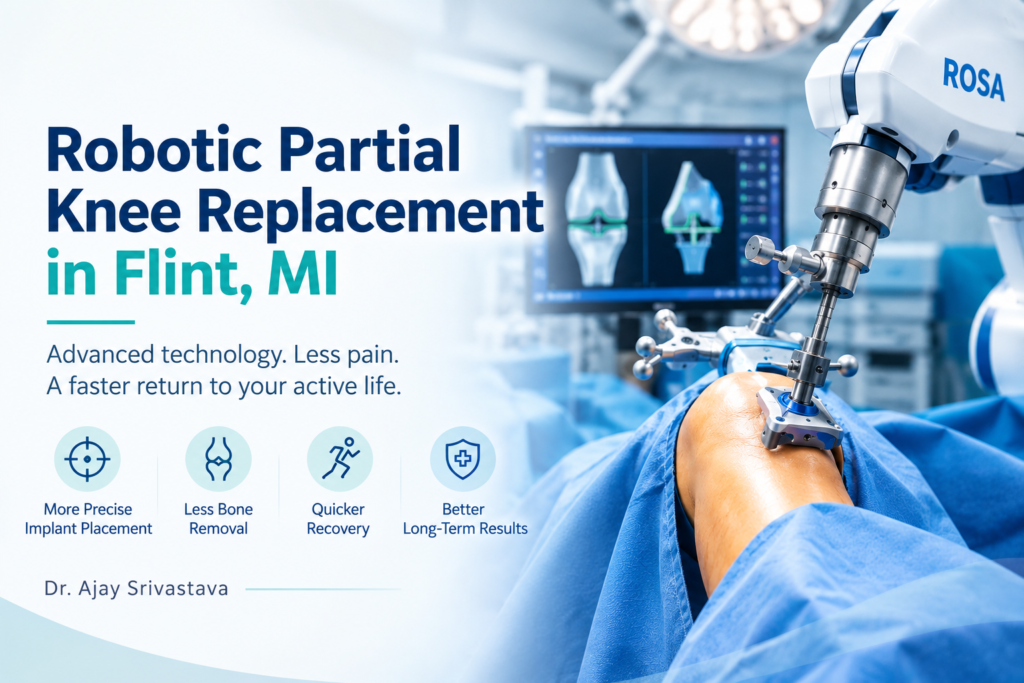
Robotic-assisted systems can help the surgeon plan the procedure around the patient’s anatomy and guide precise preparation of the affected part of the knee. During surgery, the system provides information and guidance that support the surgeon’s decisions about bone preparation and implant placement.
Dr. Srivastava’s website describes the use of robotic systems, including the ROSA® Robotic System and the TMINI® Miniature Robotic System, in his robotic-assisted surgical practice. The technology used for an individual procedure depends on the clinical plan and the surgeon’s assessment. Robotic assistance is a tool, not a guarantee of a particular result, and it does not eliminate the risks associated with surgery.
Who May Be a Candidate for Robotic Partial Knee Replacement?
A patient may be considered for partial knee replacement when arthritis is mainly confined to one compartment and the remaining parts of the knee are sufficiently healthy. The ligaments must provide appropriate stability, and the knee’s alignment and function must be considered.
During an evaluation, an orthopedic surgeon may review:
- Where the arthritis is located and how advanced it is.
- X-rays and other imaging, when indicated.
- Knee alignment, range of motion, and ligament stability.
- Pain, mobility limitations, activity goals, and previous treatments.
- Overall health, medications, and factors that may affect surgery or healing.
If arthritis affects multiple compartments or other factors make partial replacement unsuitable, total knee replacement or a non-surgical treatment may be recommended instead. Only an individualized clinical assessment can determine which option is appropriate.
What to Expect Before and After Surgery
Before surgery
Your care team will explain the procedure, review your medical history, and discuss preparation. Depending on your needs, preparation may include medical clearance, preoperative testing, medication guidance, and prehabilitation or physical therapy. Arrange transportation and plan for help at home during the early stages of recovery.
After surgery
Recovery differs by patient and procedure. Your team will provide instructions for pain control, wound care, safe movement, and follow-up visits. Physical therapy and a gradual return to activity may help rebuild strength and mobility. Follow your surgeon’s instructions and contact the care team if you have concerns.
Ask your surgeon what recovery milestones are realistic for your health, home environment, and daily activities. No specific recovery timeline or outcome can be guaranteed.
Robotic Partial vs. Total Knee Replacement
The main difference is how much of the knee is replaced. Partial knee replacement treats one damaged compartment and preserves the rest of the joint when suitable. Total knee replacement addresses more extensive arthritis involving multiple parts of the knee. Robotic assistance may be used in different types of knee replacement, depending on the surgeon’s approach and the patient’s needs.
The choice should be based on the location and severity of arthritis, stability, anatomy, goals, and the risks and benefits of each option—not on technology alone.
Choosing a Knee Replacement Specialist in Flint, Michigan
When comparing treatment options, look for a specialist who can explain the diagnosis, discuss both surgical and non-surgical options, and help you understand the expected benefits and risks. It is also important to ask about the surgeon’s experience with partial knee replacement, the role of robotic assistance in your case, rehabilitation, and follow-up care.
Dr. Ajay Srivastava is a board-certified orthopedic surgeon focused on adult hip and knee reconstruction and practices with OrthoMichigan in Flint, Michigan. Patients can explore his website to learn more about partial knee replacement, robotic surgery, and his approach to evidence-based, patient-centered care.
Discuss Your Knee Pain and Treatment Options
If knee arthritis is affecting your mobility, an evaluation can help clarify whether continued non-surgical care, partial knee replacement, or total knee replacement may be appropriate. To learn more about robotic-assisted knee surgery in Flint, visit Dr. Ajay Srivastava’s website or contact the OrthoMichigan team to discuss scheduling an appointment.
Related information: https://srivastavamd.com/partial-knee-replacement/ | https://srivastavamd.com/robotic-surgery/
Frequently Asked Questions
What is robotic partial knee replacement?
Who qualifies for partial knee replacement?
Is robotic partial knee replacement better than total knee replacement?
Does robotic-assisted knee surgery guarantee faster recovery?
Where can I learn about robotic knee surgery in Flint, MI?
You can review Dr. Ajay Srivastava’s robotic surgery information at https://srivastavamd.com/robotic-surgery/ and partial knee replacement information at https://srivastavamd.com/partial-knee-replacement/.