
Anterior Hip Replacement in Flint, MI | Hip Replacement Guide

Hip Replacement Options
Hip pain can make everyday activities such as walking, climbing stairs, getting in and out of a car, or participating in favorite activities increasingly difficult. When conservative treatments no longer provide enough relief, hip replacement surgery may be an option to consider.
For patients looking for anterior hip replacement in Flint, understanding the available surgical approaches, expected recovery, and differences between primary and revision procedures can help them have a more informed conversation with an orthopedic specialist.
This guide explains direct anterior hip replacement in Flint, total hip replacement, hip replacement surgery, and revision hip replacement, including what patients can expect before and after surgery.What Is Hip Replacement Surgery?
Hip replacement surgery is a procedure used to replace damaged portions of the hip joint with artificial components. The goal is to reduce pain and improve mobility when conditions such as advanced hip arthritis or significant joint damage interfere with daily life.
The hip is a ball-and-socket joint. During a hip replacement, damaged joint surfaces are removed and replaced with prosthetic components designed to restore the function of the joint.When Is Hip Replacement Recommended?
Hip replacement may be considered when hip pain and stiffness significantly affect a person’s quality of life and other treatments have not provided adequate relief.
- Persistent hip pain
- Difficulty walking or standing
- Pain that interferes with sleep
- Stiffness and reduced hip mobility
- Difficulty performing normal daily activities
- Pain that continues despite conservative treatment
Direct Anterior Hip Replacement in Flint
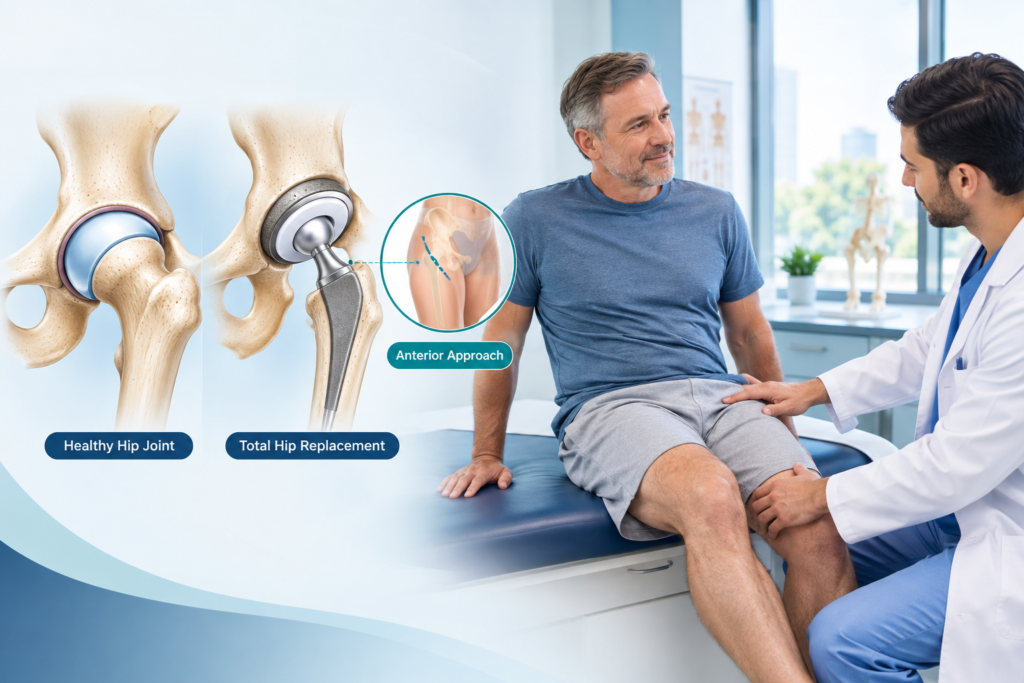
Direct anterior hip replacement in Flint is an approach to total hip replacement in which the surgeon accesses the hip joint through an incision at the front of the hip.
One potential advantage of the anterior approach is that it can allow the surgeon to work between muscles and tissues rather than cutting through certain major muscles around the hip. However, whether this approach is appropriate depends on the patient’s anatomy, diagnosis, previous surgeries, and other individual factors.
Benefits of the Anterior Approach
Patients considering anterior hip replacement in Flint may want to discuss the potential advantages and limitations of this approach with their surgeon.
- An incision at the front of the hip
- A muscle-sparing surgical approach in appropriate patients
- Potentially easier early mobility for some patients
- A focus on restoring hip function and reducing pain
- A structured rehabilitation program following surgery
Every patient is different, and recovery can vary depending on overall health, surgical complexity, activity level, and rehabilitation.
Is Direct Anterior Hip Replacement Right for Everyone?
No single surgical approach is best for every patient.
- Hip anatomy
- Bone quality
- Severity of joint damage
- Previous hip procedures
- Body structure
- Medical history
- Activity goals
A detailed evaluation can help determine whether direct anterior hip replacement in Flint is a suitable option.
Total Hip Replacement in Flint
Total hip replacement in Flint involves replacing both major damaged surfaces of the hip joint—the femoral head and the damaged portion of the socket—with artificial components.
Total hip replacement is commonly performed for patients with significant joint degeneration that causes pain, stiffness, and loss of function.What Happens During Total Hip Replacement?
During a total hip replacement procedure, the damaged femoral head is removed and replaced with an artificial component. The damaged surface of the hip socket is also prepared to receive an artificial cup.
The replacement components work together to create a new functioning hip joint.The Main Components of a Hip Replacement
- A femoral component
- A femoral head or ball
- An acetabular cup
- A bearing surface between the components
The specific implant system and materials used are selected based on the patient’s individual needs.
Who May Need a Total Hip Replacement?
A patient may be considered for total hip replacement in Flint when hip damage causes persistent symptoms and substantially affects daily activities.
- Osteoarthritis
- Rheumatoid arthritis
- Hip fracture
- Osteonecrosis
- Post-traumatic arthritis
- Other forms of severe hip joint damage
Conservative Treatments Before Hip Replacement
Before recommending surgery, an orthopedic specialist may consider nonsurgical options depending on the patient’s condition.
- Activity modification
- Physical therapy
- Assistive devices
- Medications
- Injections when appropriate
- Weight-management strategies when applicable
If these approaches no longer provide sufficient relief, surgery may become part of the discussion.
Hip Replacement Recovery in Flint, MI
Recovery after hip replacement surgery is different for every patient. Some people begin walking soon after surgery, while the overall recovery process continues for several weeks or months.
Physical therapy and following postoperative instructions can play an important role in regaining strength and mobility.What Can Patients Expect After Surgery?
- Getting up and walking with assistance
- Managing postoperative discomfort
- Beginning physical therapy
- Gradually increasing daily activities
- Using walking aids temporarily when needed
- Following restrictions provided by the surgical team
Returning to Normal Activities
The timeline for returning to work, driving, exercise, and other activities depends on the type of procedure, individual recovery, and the surgeon’s recommendations.
Patients should follow their personalized rehabilitation plan rather than comparing their recovery timeline with someone else’s.Revision Hip Replacement in Flint
A revision hip replacement in Flint is a surgical procedure performed to address problems with a previous hip replacement.
Unlike a primary hip replacement, revision surgery can be more complex because the surgeon is working around an existing implant and previously operated tissues.
Patients may need revision surgery for different reasons, depending on the condition of their hip replacement.Why Is Revision Hip Replacement Needed?
- Implant loosening
- Wear of replacement components
- Instability or repeated dislocation
- Infection
- Fracture around the implant
- Significant bone loss
- Failure or damage of an implant component
What Is Total Hip Revision?
Total hip revision refers to revision surgery involving a previous total hip replacement. Depending on the patient’s condition, the surgeon may need to replace one or more components of the original implant.
The complexity of the procedure varies significantly from patient to patient.Total Hip Revision vs. Primary Hip Replacement
|
Primary Hip Replacement |
Revision Hip Replacement |
Key Difference |
|
First hip replacement |
Surgery involving a previous hip replacement |
Revision addresses an existing implant |
|
Damaged natural joint is replaced |
Existing implant components may be removed or replaced |
Different surgical setting |
|
Generally more predictable anatomy |
Previous surgery can make the procedure more complex |
Complexity may be higher |
|
Focuses on restoring the hip joint |
Focuses on addressing the reason for implant failure |
Different treatment goals |
How Is Revision Hip Replacement Evaluated?
A patient experiencing pain or other problems after a previous hip replacement may require a detailed evaluation.
Diagnostic Evaluation
- Medical history
- Physical examination
- X-rays
- Other imaging studies when needed
- Blood tests
- Evaluation for infection
- Assessment of implant positioning and stability
The specific testing depends on the patient’s symptoms and clinical findings.
Choosing a Hip Replacement Surgeon in Flint
Choosing an experienced orthopedic specialist is an important part of the hip replacement process.
Patients researching a hip replacement surgeon in Flint, MI may want to consider the surgeon’s experience with hip replacement procedures, approach options, revision surgery when applicable, and postoperative care.
Dr. Ajay Srivastava provides information about hip replacement procedures and revision hip replacement for patients considering treatment.
Learn More About Hip Replacement
For additional information about treatment options, patients can visit the dedicated hip replacement page:
Learn More About Revision Hip Replacement
Patients who have already undergone hip replacement and are experiencing problems with their implant can learn more about revision treatment here:
Preparing for Hip Replacement Surgery
Before Surgery
- Medications
- Medical testing
- Preparing your home
- Activity before surgery
- Transportation
- Postoperative assistance
- Physical therapy
Questions to Ask Your Surgeon
- Which hip replacement approach is appropriate for me?
- Am I a candidate for direct anterior hip replacement?
- What type of implant will be used?
- How long should I expect recovery to take?
- What activities can I return to after surgery?
- What are the risks and potential complications?
- If I already have a hip replacement, what could be causing my symptoms?
Frequently Asked Questions About Hip Replacement in Flint
What is anterior hip replacement?
Is direct anterior hip replacement less painful?
How long does total hip replacement recovery take?
Recovery varies by patient. Many patients gradually return to normal activities over several weeks, while strength and function can continue improving for several months.
What is revision hip replacement?
Why would someone need a total hip revision?
How do I know if I need a hip replacement?
Is anterior hip replacement available in Flint, MI?
Talk to a Hip Replacement Specialist in Flint
If hip pain is interfering with your daily life, an orthopedic evaluation can help identify the cause of your symptoms and determine appropriate treatment options.
Whether you are researching anterior hip replacement in Flint, direct anterior hip replacement in Flint, total hip replacement in Flint, or revision hip replacement in Flint, the right treatment depends on your individual condition and goals.
Discuss your symptoms and treatment options with Dr. Ajay Srivastava to determine whether hip replacement or another treatment may be appropriate for you.